
Choosing the right scrub fit is about more than selecting a standard size. Healthcare professionals have different body proportions, movement requirements, and personal preferences, so a scrub style that works well for one person may not provide the same comfort or appearance for another.
The right fit should allow natural movement while providing appropriate coverage and a professional appearance. Factors such as shoulder width, torso length, waist placement, hip proportions, inseam length, garment cut, and fabric stretch can all affect how scrubs feel during a long workday.
Key Takeaways
- Scrub size and scrub fit are not always the same thing.
- Body proportions can affect how tops and pants fit even when the overall size is correct.
- Shoulder and chest fit are important when selecting scrub tops.
- Waist, hip, thigh, and inseam measurements matter when choosing scrub pants.
- Petite, regular, and tall lengths can help accommodate different proportions.
- Stretch fabrics can provide additional freedom of movement.
- Relaxed, classic, tailored, tapered, and jogger cuts offer different silhouettes.
- Scrubs should provide enough room for bending, reaching, walking, and other routine movements.
- Oversized clothing is not automatically more comfortable.
- Very fitted clothing can restrict movement if the garment does not provide sufficient stretch.
- Workplace dress codes should always be considered when choosing colors and styles.
Why Does Scrub Fit Matter?
Healthcare professionals can spend hours walking, standing, bending, reaching, lifting, and assisting patients. Clothing needs to accommodate those movements without constantly requiring adjustment.
An appropriate fit can help a uniform:
- Move naturally with the body
- Maintain appropriate coverage
- Reduce unnecessary fabric
- Avoid excessive tightness
- Support a professional appearance
- Remain comfortable throughout a shift
Fit is especially important because healthcare uniforms are typically worn for extended periods.
A garment that feels acceptable for a few minutes may become uncomfortable after several hours if the waistband, shoulders, sleeves, or inseam are not appropriate.
What Is the Difference Between Scrub Size and Scrub Fit?
Size generally refers to the manufacturer’s sizing system, while fit describes how the garment actually sits on the body.
Two people can wear the same numerical or letter size and have very different preferences for how their scrubs should fit.
For example, one person may prefer:
- A relaxed torso
- A straight leg
- A longer top
Another may prefer:
- A closer-fitting top
- A tapered pant
- A shorter or more defined silhouette
This is why checking measurements and garment-specific sizing information is often more useful than relying on size labels alone.
How Do You Measure for Scrubs?
The exact measurements needed depend on the garment.
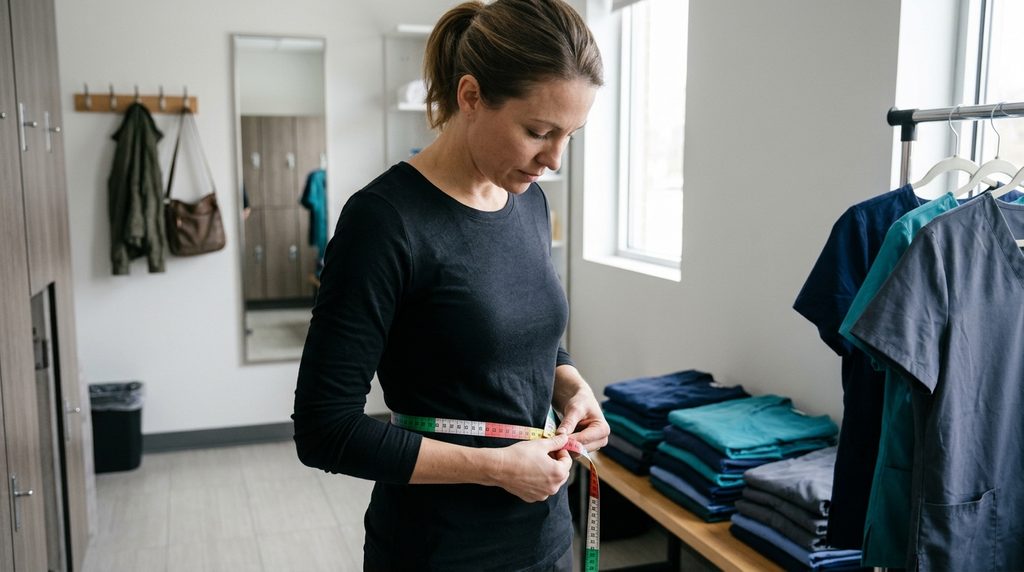
For scrub tops
Common measurements include:
- Chest or bust
- Waist
- Hip
- Shoulder width
- Overall length
For scrub pants
Common measurements include:
- Waist
- Hip
- Inseam
- Rise
Use the manufacturer’s size chart whenever possible because measurement ranges can vary between brands and collections.
A garment’s cut can also affect the final fit even when the measurements appear similar.
How Should Scrub Tops Fit?
A scrub top should provide enough room for natural movement without becoming excessively loose.
Pay particular attention to:
Shoulders
The shoulder seam should generally sit in an appropriate position rather than extending far down the upper arm.
If the shoulders are too narrow, arm movement can feel restricted.
If they are excessively wide, the garment can look oversized.
Chest or bust
The garment should provide sufficient room without excessive pulling across the front.
Torso
The torso should allow bending and reaching without becoming excessively tight or creating unnecessary fabric.
Length
The top should provide appropriate coverage during normal movement.
What Scrub Fit Works Best for Different Body Shapes?
There is no universally correct fit for any particular body shape.
Instead, different proportions may make certain garment features more useful.
People with broader shoulders
A top with sufficient shoulder and upper-body room can help prevent restriction during arm movement.
Stretch fabric can also provide additional flexibility.
People with a longer torso
Longer scrub tops can provide more comfortable coverage, particularly during bending or reaching.
People with a shorter torso
A less elongated top may create a more balanced appearance and reduce excess fabric.
People with fuller hips
Scrub pants should provide sufficient hip and thigh room without requiring an excessively large waist size.
People with narrower hips
A waistband and cut that sit securely at the waist can help prevent the pants from shifting during movement.
These are general fit considerations rather than rules. Personal preference remains important.
How Should You Choose Scrubs for a Curvier Figure?
People with more pronounced differences between waist, hip, and bust measurements may need to pay closer attention to garment proportions.
For scrub tops, consider:
- Bust room
- Waist shape
- Overall length
- Side movement
- Stretch
For scrub pants, consider:
- Hip measurement
- Waistband construction
- Thigh room
- Rise
- Stretch
- Inseam
A garment that accommodates the largest measurement without considering the other proportions may create excess fabric elsewhere.
What Scrub Fit Works for an Athletic or Broad Build?
People with broader shoulders or more muscular arms may benefit from tops that provide sufficient room through the upper body.
Look for:
- Comfortable shoulder width
- Adequate sleeve room
- Flexible fabric
- Sufficient chest room
- Appropriate torso length
For pants, the waist, hip, thigh, and rise should all be considered rather than relying only on waist size.
What Scrub Fit Works for a Slimmer Build?
A slimmer body type does not necessarily require extremely fitted scrubs.
A tailored or contemporary cut can provide a cleaner silhouette while still allowing movement.
Important considerations include:
- Shoulder placement
- Waist shape
- Overall length
- Sleeve proportions
- Pant leg width
The goal should be comfortable movement rather than simply choosing the narrowest available cut.
How Do Petite Scrubs Differ From Regular-Length Scrubs?
Petite scrub pants are generally designed for shorter proportions, particularly through the inseam and overall garment dimensions.
This can help reduce the need for alterations.
When evaluating petite pants, consider:
- Inseam
- Rise
- Waist placement
- Knee placement
- Overall leg proportion
Petite sizing does not simply mean choosing a smaller size.
A person can have a smaller overall frame but still require a particular waist or hip measurement.
When Should You Choose Tall Scrub Pants?
Tall scrub pants can be useful for people who need additional length through the leg.
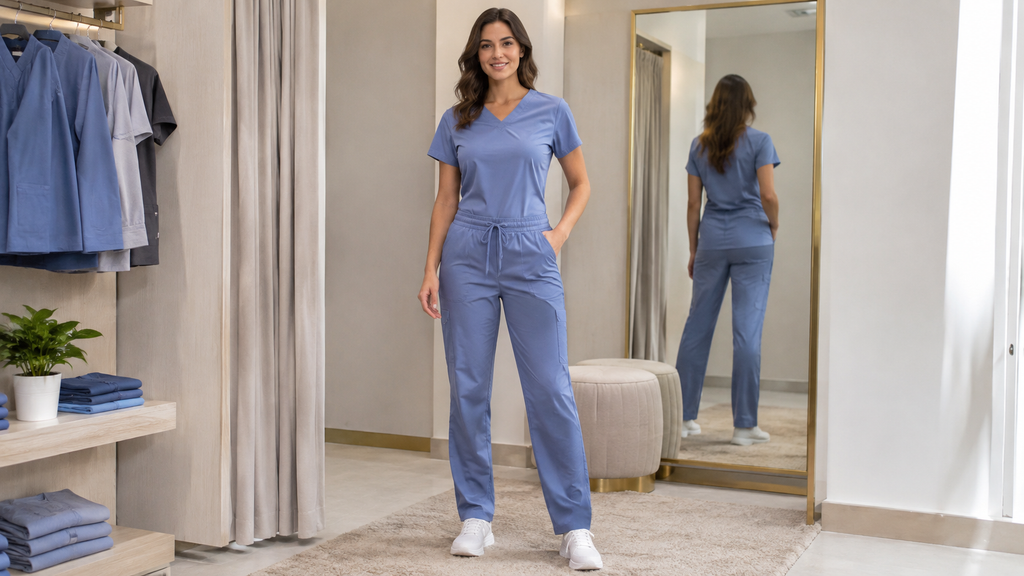
Important considerations include:
- Inseam
- Rise
- Knee placement
- Overall proportion
- Waist and hip measurements
Choosing a larger standard size simply to gain additional length may result in an unnecessarily loose fit through the waist or hips.
A dedicated tall length can provide a more appropriate solution when available.
What Are Regular-Length Scrub Pants?
Regular-length pants are designed around standard proportions and can work well for many healthcare professionals.
They may be appropriate when:
- The inseam is suitable
- The rise feels comfortable
- The waistband sits correctly
- The leg reaches the desired point
- No alteration is necessary
Regular length should not automatically be treated as the default choice for every body type.
Are Jogger Scrubs Good for Different Body Types?
Jogger scrubs have a tapered leg and typically finish closer to the ankle.
They can create a contemporary silhouette while allowing movement.
When choosing joggers, consider:
- Waistband comfort
- Hip room
- Thigh room
- Taper
- Ankle opening
- Inseam
The tapered leg should not become so narrow that it restricts movement.
Joggers can work across many body types when the waist, hip, thigh, and length are appropriate.
Should Scrub Pants Be Tight or Loose?
Scrub pants should generally provide enough room for movement without excessive looseness.
Too-tight pants may restrict:
- Squatting
- Bending
- Walking
- Sitting
- Climbing stairs
Excessively loose pants can:
- Create unnecessary fabric
- Shift during movement
- Interfere with footwear
- Appear oversized
The appropriate fit is usually somewhere between restriction and excessive volume.
How Should Scrub Waistbands Fit?
The waistband should remain secure without creating excessive pressure.
A comfortable waistband should:
- Stay in place during movement
- Allow normal sitting and bending
- Avoid excessive digging
- Work comfortably with the chosen rise
Elastic, drawstring, stretch, and other waistband constructions can provide different fit experiences.
The best option depends on personal preference and garment design.
How Important Is the Rise of Scrub Pants?
Rise describes the distance between the crotch and waistband.
It can influence:
- Waist placement
- Coverage
- Comfort while sitting
- How the pants move during bending
- Overall silhouette
A rise that is too short can feel restrictive, while an excessively long rise can create excess fabric.
The correct rise is particularly important for professionals who spend much of the shift bending or sitting.
How Should Scrub Sleeves Fit?
Sleeves should provide enough room for natural arm movement.
Check whether you can comfortably:
- Raise your arms
- Reach forward
- Bend your elbows
- Move equipment
- Perform routine work activities
The sleeve opening should also feel comfortable without excessive tightness around the upper arm.
How Does Fabric Stretch Affect Scrub Fit?
Stretch can make a garment more adaptable to movement.
A stretch fabric may provide additional flexibility when:
- Reaching
- Bending
- Sitting
- Walking
- Lifting
- Turning
However, stretch does not compensate for an incorrect size.
A garment that is fundamentally too small may remain uncomfortable even if the material has considerable stretch.
Should You Choose Relaxed or Tailored Scrubs?
The choice depends on personal preference and work requirements.
Relaxed fit
A relaxed fit generally provides more room through the body.
It can appeal to people who prioritize:
- Maximum ease of movement
- A less structured silhouette
- Additional layering room
Tailored fit
A tailored fit generally follows the body’s shape more closely.
It can appeal to people who prefer:
- A cleaner silhouette
- Less excess fabric
- A more contemporary appearance
Neither is inherently more professional.
The garment should allow appropriate movement and coverage.
Are Unisex Scrubs a Good Option?
Unisex scrubs can be practical in workplaces where a shared uniform style is preferred.
However, body proportions can differ significantly between individuals.
A unisex garment may work well for one person while requiring a different size or cut for another.
Consider:
- Shoulder width
- Chest
- Waist
- Hip
- Overall length
- Inseam
The availability of women’s and men’s medical scrubs can provide more options when a gender-specific cut is preferred.
How Should Women Choose Scrub Fits?
Women’s scrub collections can offer cuts designed around different proportions.
When selecting women’s scrubs, consider:
- Bust measurement
- Waist
- Hip
- Shoulder width
- Top length
- Pant inseam
- Leg shape
- Preferred silhouette
The right choice depends on the individual’s proportions rather than simply selecting a particular style because it is marketed toward women.
How Should Men Choose Scrub Fits?
Men’s scrub collections can offer different proportions and garment cuts.
When selecting men’s scrubs, consider:
- Chest
- Shoulder width
- Waist
- Hip
- Sleeve length
- Torso length
- Inseam
- Leg shape
A professional who has broader shoulders may need more room in the upper body without necessarily needing a larger waist size.
How Should You Choose Scrubs for Long Shifts?
Long shifts make fit particularly important because small discomforts can become more noticeable over time.
Prioritize:
- Comfortable waistbands
- Appropriate inseam
- Breathable fabric
- Useful stretch
- Non-restrictive shoulders
- Practical pockets
- Appropriate garment length
Try to evaluate the complete outfit rather than each garment separately.
A comfortable top may still feel restrictive if the pants have a tight waistband or insufficient thigh room.
How Should Scrubs Fit When Sitting?
Healthcare professionals may spend part of their shift sitting at desks, stations, treatment areas, or during documentation.
The uniform should remain comfortable when sitting.
Check:
- Waistband pressure
- Rise
- Top length
- Back coverage
- Thigh room
A garment that feels comfortable only while standing may not be suitable for a full workday.
How Should Scrubs Fit When Bending?
Bending can expose problems that are not obvious while standing.
When bending, the uniform should maintain appropriate coverage and should not pull excessively across the shoulders, hips, waist, or thighs.
Adequate fabric stretch and appropriate garment length can help.
Workplace requirements should also be considered when determining how much coverage is appropriate.
How Should You Choose Scrub Length?
Length applies to both tops and pants.
For tops, consider:
- Torso length
- Coverage while bending
- Preferred silhouette
- Waist and hip proportions
For pants, consider:
- Inseam
- Shoe height
- Desired ankle position
- Leg shape
The correct length can improve both comfort and appearance without requiring a larger or smaller overall size.
Should Scrub Tops and Pants Be the Same Size?
Not necessarily.
Body proportions often mean that the most comfortable top and pant sizes differ.
For example, someone may require:
- A larger top because of shoulder or chest measurements
- A smaller pant size because of waist and hip proportions
Scrub separates make it possible to select each garment based on its actual fit requirements.
This is one reason separate tops and pants can provide more flexibility than relying exclusively on pre-matched sets.
How Can You Tell If Scrubs Are Too Small?
Common signs include:
- Pulling across the chest
- Restricted shoulder movement
- Excessive tension at the waist
- Tightness around the hips or thighs
- Limited range of motion
- Sleeves that feel restrictive
- Pants that become uncomfortable when sitting
If several of these issues occur, consider checking measurements rather than simply moving to a different style without identifying the underlying fit problem.
How Can You Tell If Scrubs Are Too Large?
Common signs include:
- Excessive fabric around the torso
- Drooping shoulders
- Waistband movement
- Pants pooling excessively
- Sleeves extending too far
- Excessively wide pant legs
Moving down one size may help, but the issue can also be related to the garment’s cut.
A different fit may provide better proportions without significantly changing the overall size.
How Should You Choose Scrubs for Different Proportions?
A useful approach is to identify the areas that most influence fit.

| Body Proportion | What to Check |
| Broader shoulders | Shoulder width, chest, sleeve room |
| Longer torso | Top length, overall coverage |
| Shorter torso | Top length, excess fabric |
| Fuller hips | Hip and thigh room, waistband |
| Narrower hips | Waist fit, pant stability |
| Longer legs | Inseam and rise |
| Shorter legs | Petite or shorter inseam options |
| Larger upper arms | Sleeve opening and stretch |
| Long arms | Sleeve length |
| Athletic build | Shoulder, chest, thigh and seat room |
These are starting points rather than rigid rules. Actual measurements and personal comfort should determine the final choice.
How Important Is Trying on Scrubs?
Trying on clothing can help identify fit issues that measurements alone may not reveal.
When possible, evaluate the garment while performing movements similar to those required at work.
Try:
- Reaching forward
- Raising your arms
- Sitting
- Bending
- Walking
- Squatting
The uniform should remain comfortable and appropriately positioned throughout normal movement.
When shopping online, review the size chart, garment measurements, material information, and return policy before purchasing.
Should Healthcare Professionals Have Different Scrub Fits?
Having more than one fit can be useful.
For example, someone may prefer:
- A relaxed fit for long shifts
- A tailored top for a more structured appearance
- Jogger pants for mobility
- Straight-leg pants for a traditional silhouette
Different fits can also be useful for different seasons or work environments.
The important point is to choose styles that are actually worn rather than accumulating garments simply for variety.
What Role Does Personal Preference Play in Scrub Fit?
Personal preference is an important part of selecting workwear.
Two people with very similar measurements may prefer completely different silhouettes.
One may prioritize:
- Loose movement
- Larger pockets
- Traditional cuts
Another may prefer:
- Tailored shapes
- Tapered pants
- Contemporary styling
As long as the garment meets workplace requirements and supports appropriate movement, personal preference can guide the final decision.
How Should Workplace Dress Codes Influence Fit?
Workplace policies can influence more than color.
Some employers may specify:
- Approved colors
- Garment styles
- Sleeve requirements
- Department-specific uniforms
- Professional appearance standards
Always check workplace requirements before building a wardrobe around a particular style.
A garment that fits perfectly may still be unsuitable if it does not meet the organization’s uniform policy.
Common Scrub Fit Mistakes
Choosing a Size Based Only on Height
Height does not determine waist, hip, chest, or shoulder measurements.
Buying a Larger Size to Gain Length
A larger size can provide extra length while creating unnecessary width elsewhere.
Petite or tall options may provide a better solution when available.
Assuming Tight Means Tailored
A tailored fit should still allow comfortable movement.
Assuming Loose Means Comfortable
Excess fabric can interfere with movement and create unnecessary bulk.
Ignoring the Inseam
Pant length can have a major effect on overall fit.
Choosing Only by Appearance
A garment may look good while standing but feel restrictive when sitting or bending.
Ignoring Fabric Stretch
Fabric composition can affect how a garment responds to movement.
Scrub Fit Checklist
| Area | What to Check |
| Shoulders | Seam position and arm movement |
| Chest/Bust | No excessive pulling |
| Waist | Comfortable without excessive pressure |
| Hips | Adequate room for movement |
| Sleeves | Comfortable arm movement |
| Top length | Appropriate coverage |
| Rise | Comfortable when sitting and bending |
| Inseam | Appropriate leg length |
| Thighs | Sufficient movement |
| Fabric | Stretch and breathability |
| Pockets | Useful without excessive weight |
| Overall fit | Comfortable throughout normal work movements |
Where Can You Find Different Scrub Fits?
Healthcare professionals can explore different garment cuts and sizing options based on their individual proportions.
A women’s scrubs collection can provide different women’s styles, while a men’s scrubs collection can provide options designed around men’s proportions.
For professionals who want to explore a broader selection of medical scrubs online, reviewing garment-specific sizing information can help narrow down appropriate styles.
Those who prefer to evaluate fit and fabric in person can visit a medical uniform retailer and assess different options before purchasing.
Frequently Asked Questions
How should scrubs fit?
Scrubs should provide enough room for natural movement while maintaining appropriate coverage and a professional appearance. They should not pull excessively across the shoulders, chest, waist, hips, or thighs, nor should they contain excessive fabric that interferes with movement.
Should scrubs be loose or fitted?
Neither extreme is ideal for everyone. A practical fit should provide enough room to bend, reach, sit, and walk comfortably without excessive fabric. Personal preference, garment construction, and workplace requirements should all be considered.
How do I choose the right scrub size?
Start with your measurements and compare them with the manufacturer’s size chart. For tops, consider chest or bust, waist, shoulders, and length. For pants, consider waist, hips, rise, and inseam.
What are the best scrub pants for shorter people?
Petite or shorter-length scrub pants can provide a better proportion for people who find standard inseams too long. Choosing a smaller overall size solely to reduce length may create an incorrect fit through the waist and hips.
Are tall scrub pants better for people with long legs?
Tall scrub pants can provide additional inseam and proportion for people who find regular-length pants too short. They allow the wearer to maintain an appropriate waist and hip size while gaining additional length.
Can you wear different scrub sizes for tops and pants?
Yes. Tops and pants do not need to be the same size. Different body proportions can make separate sizing more comfortable, particularly when chest, shoulder, waist, hip, or thigh measurements differ significantly.
Conclusion
Choosing the right scrub fit requires more than identifying a size on a label. Body proportions, garment construction, fabric stretch, inseam, rise, and personal preferences all influence how healthcare uniforms feel and perform during a workday.
A good fit should support movement while maintaining appropriate coverage. Healthcare professionals should be able to bend, reach, sit, walk, and perform normal work activities without excessive pulling or unnecessary fabric.
Different proportions may benefit from different approaches. Petite and tall lengths can help solve inseam issues, while different top and pant cuts can accommodate variations in shoulders, chest, waist, hips, and thighs.
The distinction between relaxed, tailored, tapered, and jogger styles also gives professionals more control over their preferred silhouette. However, the most fashionable option is not automatically the most practical one. Workplace requirements, comfort, and mobility should remain central to the decision.
Fabric also matters. Stretch can improve freedom of movement, while breathable and appropriately weighted materials can contribute to long-shift comfort. Still, fabric cannot compensate for a fundamentally incorrect size or proportion.
Ultimately, the best scrubs are those that fit the individual rather than forcing the individual to adapt to the garment. By taking accurate measurements, reviewing garment-specific sizing information, considering body proportions, and evaluating movement, healthcare professionals can build a scrub wardrobe that provides a more comfortable and practical fit throughout the workday.