
Choosing medical scrubs is not simply a matter of picking a color and size. Healthcare professionals need workwear that fits their role, movement patterns, workplace requirements, and personal comfort needs. When comparing medical scrubs online, the most useful approach is to evaluate fit, fabric, pocket layout, garment style, and expected shift demands before choosing a set.
The right scrubs should support normal movement without constant adjustment, provide practical storage for the job, and maintain an appropriate professional appearance throughout the workday. Individual facility rules should always come first, especially when colors, uniform styles, or additional protective clothing are required.
Quick Answer
The best medical scrubs for healthcare work are those that meet workplace dress requirements while providing the right balance of fit, mobility, fabric performance, and practical storage.
Before choosing scrubs, consider:
- Workplace color and uniform rules
- Job duties and typical movement
- Preferred fabric weight and stretch
- Top length and shoulder fit
- Pant rise, inseam, and leg shape
- Number and position of pockets
- Layering needs
- Laundry and care requirements
- Whether separate workplace PPE is required
No single scrub style is best for every healthcare worker. A nurse moving between patient rooms may prioritize stretch and pocket storage, while a medical office professional may place greater emphasis on a structured, coordinated appearance.
Why does choosing the right medical scrubs matter?
Medical uniforms are worn during long periods of standing, walking, reaching, bending, sitting, and performing repetitive tasks. A garment that feels acceptable for a few minutes in a fitting room can become distracting when the waistband shifts, shoulders pull, pockets sag, or pant hems interfere with movement.
Good scrub selection reduces these avoidable clothing problems.
The goal is not to find a universally perfect scrub. It is to identify the design features that match the wearer’s actual workday.
A practical scrub wardrobe usually needs to address three questions:
- Does the uniform meet workplace requirements?
- Does the fit support normal movement?
- Does the garment provide the features required for the role?
These questions should be answered before style preferences are considered.
Start with the healthcare workplace dress code
The first step is checking the employer’s uniform policy.
Some healthcare organizations assign colors by department or professional role. Others specify acceptable uniform styles, logo requirements, footwear rules, or outerwear restrictions. A scrub set can fit perfectly and still be unsuitable if it does not meet the facility’s dress standards.
Check color requirements before buying
Do not assume that every shade described with the same general color name will look identical.
Navy, royal blue, ceil blue, pewter, wine, and other common scrub colors may vary between manufacturers or collections. Even garments from the same manufacturer can use different fabric blends or dye processes across collections.
For a coordinated set, buying a top and pant from the same collection is often the simplest approach.
This becomes especially important for healthcare offices trying to maintain a consistent team appearance.
Understand the difference between scrubs and PPE
Ordinary medical scrubs should not automatically be treated as personal protective equipment.
OSHA explains that general work clothing, including uniforms and clothing not intended to protect against a workplace hazard, is not considered PPE under its Bloodborne Pathogens standard. OSHA also requires employers to assess workplace hazards and select appropriate protective equipment when hazards necessitate PPE.
The OSHA personal protective equipment requirements and the CDC Standard Precautions guidance are useful references for understanding why work uniforms and task-specific protective equipment serve different purposes.
The CDC recommends PPE when exposure to infectious material is expected.
Healthcare workers should therefore follow employer infection-control and PPE policies rather than assuming a particular scrub fabric replaces gowns, gloves, masks, or other required protective equipment.
How should medical scrubs fit?
Proper scrub fit sits between excessive looseness and restrictive tightness.
Scrubs should allow routine healthcare movements while maintaining appropriate coverage and a professional silhouette.
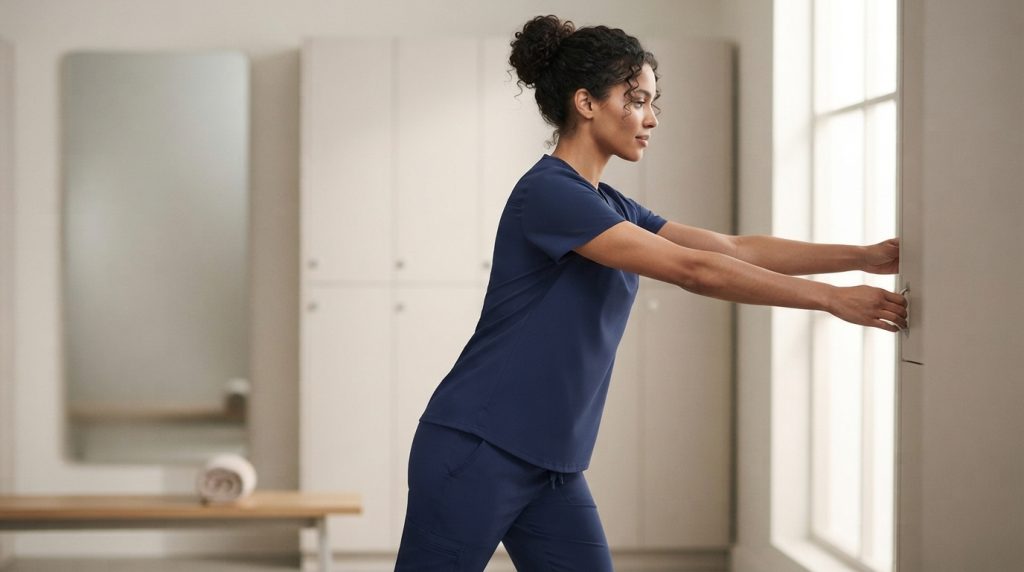
Check the shoulders and upper body first
For scrub tops, shoulder fit provides an early indication of whether the size is appropriate.
The shoulder seams should sit reasonably close to the natural shoulder area. A top that pulls tightly across the shoulders can restrict reaching. An excessively oversized top may shift, gape, or create extra fabric around the torso.
Test the top by performing common movements:
- Reach both arms forward
- Raise the arms
- Cross the arms over the chest
- Bend slightly at the waist
- Sit and stand
- Reach toward a low surface
The garment should move with the body without requiring constant repositioning.
Pay attention to scrub top length
Top length is partly a matter of preference, but it also affects coverage and proportion.
A longer top may offer more coverage during bending and reaching. A shorter or tuckable top may create a more fitted appearance and pair well with higher-rise scrub pants.
Healthcare professionals who frequently lean, lift, or reach should check the garment from multiple positions rather than evaluating the fit only while standing upright.
Evaluate pant rise and waistband style
Scrub pants are available with different rise and waistband constructions.
Common options include:
- Mid-rise pants
- Higher-rise pants
- Full elastic waistbands
- Drawstring waists
- Yoga-style waistbands
- Combination elastic and drawstring designs
The right choice depends on comfort and movement preferences.
A waistband that feels comfortable while standing may become restrictive when sitting for extended periods. Conversely, a loose waistband may require repeated adjustment during a physically active shift.
Movement testing is particularly important when selecting comfortable medical scrubs, because women’s scrub categories can include jogger, tapered, flare, straight, petite, regular, and tall options rather than a single standard pant shape.
How do petite, regular, and tall scrub lengths differ?
Pant length should be selected according to the actual inseam and intended leg style.
Height alone does not always determine the correct scrub length. Two people of the same height can have different leg and torso proportions.
Petite scrub pants
Petite-length pants are designed around a shorter proportion or inseam.
They may help reduce:
- Fabric gathering around the ankle
- Pant hems dragging near the floor
- Distortion of a tapered leg shape
- Jogger cuffs sitting too low
Petite sizing should not automatically be confused with a smaller waist size. Length and overall garment size are separate fit decisions.
Regular-length scrub pants
Regular length is the standard option for many collections, but the exact inseam can still vary by style and manufacturer.
Bootcut, flare, straight, and tapered pants may also appear to fit differently even when their stated length is similar.
Tall scrub pants
Tall-length styles provide additional length for workers who need a longer inseam.
Buying a larger standard size simply to gain additional pant length can create unnecessary room in the waist, hip, or thigh. A dedicated tall-length option generally addresses the inseam more directly.
Always review the specific sizing information available for the garment or collection being considered.
Which scrub pant style works best?
The best pant style depends on movement, storage needs, fit preference, and workplace appearance standards.

Jogger scrub pants
Joggers typically use a tapered leg and fitted ankle cuff.
They are popular with healthcare professionals who prefer a close lower-leg fit and an athletic-inspired silhouette. The cuff can also keep excess pant fabric from gathering around the shoe.
When evaluating joggers, check whether the cuff sits comfortably and whether the knee and thigh areas allow sufficient movement.
Tapered scrub pants
Tapered pants gradually narrow toward the ankle without necessarily using a jogger cuff.
This style can create a streamlined appearance while retaining the structure of traditional scrub pants.
Straight-leg scrub pants
Straight-leg styles maintain a more consistent width through the lower leg.
They are a practical option for workers who prefer a traditional professional silhouette or additional room below the knee.
Flare and bootcut scrub pants
Flare and bootcut designs widen toward the lower leg.
Footwear matters when choosing these styles. The hem should work with the shoes normally worn during a shift and should not create excessive fabric near the floor.
What scrub fabric features should healthcare workers consider?
Fabric descriptions can become confusing because manufacturers use different blends and collection-specific terminology.
Instead of focusing only on marketing terms, consider how the fabric needs to perform during the workday.
Stretch and mobility
Stretch can help a garment move during bending, reaching, and repeated position changes.
However, stretch alone does not guarantee a good fit. A poorly proportioned garment can still pull or shift even when the fabric contains stretch fibers.
The cut of the garment and fabric construction should be considered together.
Fabric weight
Lightweight fabric may feel more comfortable in warm environments or during active work.
Some professionals prefer a slightly more substantial material because it provides greater structure.
Neither preference is universally correct.
Consider:
- Workplace temperature
- Amount of physical activity
- Layering habits
- Personal preference for drape or structure
Breathability and layering
Workers who regularly wear underscrubs, jackets, or lab coats should consider the full uniform system.
A scrub top that feels comfortable alone may feel different beneath a jacket. Similarly, a heavier fabric combination may be less comfortable in a warm clinical setting.
Layer garments in the same way they will be worn at work when testing fit and comfort.
Care requirements
Read garment care instructions before purchasing.
The CDC includes careful handling of textiles and laundry among its Standard Precautions recommendations, and its healthcare laundry guidance discusses uniforms and scrub suits within healthcare textiles.
The CDC healthcare laundry guidance provides broader infection-control information for healthcare textiles. Facility policies should be followed when clothing becomes contaminated or requires special handling.
For routine garment care, also follow the manufacturer’s washing and drying instructions. Fabric blends can respond differently to high heat and other care methods.
How many pockets do healthcare workers need?
More pockets are not automatically better.
The correct pocket configuration depends on what the worker actually carries.
Before selecting a scrub top or pant, list the items routinely kept on the uniform. Depending on the role and workplace policy, these may include pens, small notebooks, scissors, work phones, or other approved tools.
Then consider where those items are most comfortable.
Chest pockets
A chest pocket may work well for pens or lightweight items.
Heavy objects can pull the upper portion of the scrub top forward.
Patch and side pockets
Lower top pockets provide accessible storage and can distribute items away from the chest.
Check pocket depth and opening shape if several small items are routinely carried.
Cargo pockets
Cargo pant pockets offer additional storage along the thigh.
They can be useful for active roles, but overloading a single cargo pocket may cause the pant leg to pull unevenly.
Zippered pockets
A zippered compartment can help secure small personal items.
The key is choosing pockets according to real use rather than selecting a garment solely because it has the highest advertised pocket count.
Should healthcare workers choose scrub sets or separates?
Matching sets simplify color coordination and can create a consistent appearance.
Separates provide more flexibility.
A healthcare worker may need one size in scrub tops and another in pants. Others may prefer a tuckable top with a high-rise pant, a relaxed top with tapered pants, or a traditional top with joggers.
Buying separates makes it easier to build a uniform around individual proportions.
It also allows professionals to compare professional medical scrubs across men’s tops, pants, joggers, jackets, and lab coat categories rather than assuming one complete set will meet every fit requirement.
For team uniforms, employers may choose a defined brand, collection, or color while allowing employees to select from approved top and pant styles.
How many sets of scrubs are practical?
There is no universal number.
The answer depends on:
- Number of scheduled workdays
- Laundry frequency
- Employer uniform rules
- Whether uniforms are changed during a shift
- Seasonal layering needs
- Personal backup preferences
A useful approach is to plan around the actual laundry cycle.
Someone who works several consecutive shifts may need enough approved uniforms to avoid depending on immediate laundering between workdays.
An additional backup set can also be practical, particularly when work clothing becomes unexpectedly soiled or damaged.
Common mistakes when buying medical scrubs
Choosing size only by habit
A medium in one collection may not feel identical to a medium in another.
Review the size information for the specific garment and focus on actual fit.
Buying pants without checking inseam options
Workers often compensate for incorrect length by changing the overall size.
Check whether petite, short, regular, or tall options are available first.
Ignoring workplace color policies
Confirm approved colors before investing in multiple sets.
Selecting pockets without considering placement
A pocket is only useful when it can comfortably hold the items needed during work.
Assuming scrubs replace required PPE
General work uniforms and hazard-specific protective equipment serve different purposes under workplace safety guidance.
Prioritizing appearance over movement
A scrub style should still allow normal work movements.
Always test sitting, bending, reaching, and walking before deciding that a fit is suitable.
How to choose medical scrubs step by step
Use this simple selection process:
- Confirm the workplace dress code. Check approved colors, logos, outerwear, and style requirements.
- Identify the main work movements. Consider walking, bending, reaching, sitting, or repeated position changes.
- Choose the preferred top fit. Evaluate shoulders, chest, sleeve opening, and garment length.
- Select the correct pant length. Compare petite, short, regular, and tall options where available.
- Choose a pant shape. Consider jogger, tapered, straight, bootcut, or flare styles.
- Evaluate fabric preferences. Think about weight, stretch, structure, and layering.
- Review pocket placement. Match storage to real work needs.
- Test movement. Sit, reach, walk, and bend in the garment.
- Review care instructions. Make sure the garment fits the normal laundry routine.
- Buy around the work schedule. Maintain enough approved uniforms for practical rotation.
Professionals who prefer to evaluate different uniform categories or fit options in person may also use a local medical uniform store in Wilmington when considering their workwear choices.
Final thoughts
Choosing medical scrubs should begin with the realities of healthcare work rather than fashion alone. Workplace requirements establish the basic rules, while fit, movement, fabric, pockets, and garment length determine whether a uniform remains practical throughout repeated wear.
The strongest scrub wardrobe is usually built intentionally. Evaluate each garment according to the job, test how it moves, and choose styles that work together with required workplace clothing and protective equipment.
A well-selected scrub set should feel appropriate at the beginning of a shift and continue supporting normal work activities without becoming a repeated distraction.
Frequently Asked Questions
What should healthcare workers look for when buying scrubs?
Healthcare workers should consider workplace dress codes, fit, mobility, fabric weight, stretch, pocket placement, pant length, and garment care. The best choice depends on the worker’s role and normal movement patterns rather than one universal scrub style.
Are tighter or looser scrubs better?
Neither extremely tight nor excessively loose scrubs are ideal for every worker. Scrubs should provide enough room for normal bending, reaching, sitting, and walking while maintaining appropriate coverage and a professional fit. Movement testing is more useful than judging the garment only while standing.
What is the most comfortable scrub pant style?
Comfort depends on body proportions and work activity. Joggers offer a tapered ankle, straight-leg pants provide a traditional shape, and yoga-style or elastic waistbands may feel different during prolonged sitting and movement. Rise, inseam, and waistband construction should all be considered.
How do I know whether I need petite or tall scrub pants?
Measure or review the inseam of pants that already fit well, then compare that information with the sizing details for the scrub style being considered. Height alone does not always determine pant length because leg and torso proportions vary.
Are medical scrubs considered PPE?
Ordinary uniforms or scrubs are generally not considered personal protective equipment when they are not intended to protect against workplace hazards. OSHA distinguishes general work clothing from specialized protective equipment, while employers must identify hazards and require suitable PPE where necessary.