
Short-length and petite scrub pants are not always the same. Short-length pants generally address a shorter inseam while keeping proportions closer to the regular version. Petite scrub pants may adjust several vertical proportions, including the inseam, rise, knee placement, taper, and pocket position.
The correct choice depends on where regular scrub pants fit incorrectly. If the only problem is excess fabric at the hem, short length may be enough. If the rise, knees, pockets, and overall proportions also sit too low, petite sizing may provide a better fit.
Quick Answer
The basic difference is:
- Short-length scrub pants are typically designed for someone who needs a shorter leg length but otherwise fits the proportions of regular sizing.
- Petite scrub pants may be proportioned for a shorter lower-body frame, potentially changing the rise, knee position, pocket placement, and leg shape as well as inseam.
- Choose short length if regular pants fit properly through the waist, rise, hips, and knees but are simply too long.
- Consider petite sizing if regular pants also sag through the rise, bunch around the knees, place cargo pockets too low, or taper in the wrong place.
- Always check the specific manufacturer’s measurements because sizing terminology is not completely standardized across apparel collections.
Height alone should not determine the decision. Actual body and garment measurements provide a better guide.
Why Are Short and Petite Scrub Pants Often Confused?
Both categories are designed to solve problems associated with excessive pant length, so they can appear interchangeable at first.
A healthcare professional might try on regular scrub pants and notice:
- Fabric collecting around the shoes
- A hem that drags
- Bunching behind the knees
- Jogger cuffs sitting too low
- Excess material through the lower leg
Choosing either a short or petite version may reduce some of these issues.
The difference becomes clearer when the upper proportions of the pants are examined.
If the waistband, rise, hips, thighs, knees, and pockets already sit correctly, the wearer may simply need a shorter inseam.
If several vertical points are positioned too low, shortening the hem alone may not solve the problem.
NIST’s work on body dimensions for apparel reflects the broader principle that apparel fit relies on multiple body dimensions rather than overall height alone. (NIST)
What Are Short-Length Scrub Pants?
Short length scrub pants are generally intended for wearers who need less leg length than the manufacturer’s regular inseam provides.
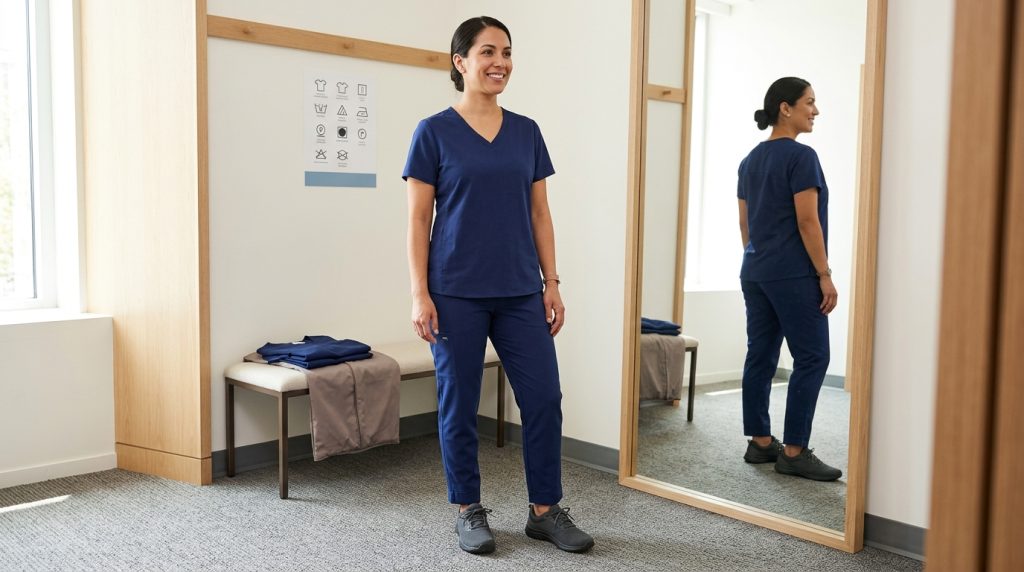
The most significant adjustment is often the inseam.
Depending on the specific collection, other proportions may remain relatively similar to regular sizing.
Short length may work well when:
- The waistband fits properly
- The rise feels comfortable
- Hip and thigh proportions are correct
- Knee placement looks natural
- Pockets sit in useful positions
- Only the lower leg is too long
- The hem drags or stacks around footwear
This is commonly a leg-length problem rather than a complete proportional problem.
Example
Suppose a pair of regular scrub pants fits comfortably through the waist, hips, thighs, and rise.
The knee sits correctly, and cargo pockets are positioned comfortably along the thigh.
The only problem is two inches of excess fabric at the ankle.
In that situation, a short-length version of the same pant may solve the issue without changing the rest of the fit.
What Are Petite Scrub Pants?
Petite scrub pants may be designed around shorter overall vertical proportions.
Depending on the manufacturer, petite sizing can alter:
- Inseam
- Front rise
- Back rise
- Hip-to-knee distance
- Knee placement
- Cargo pocket position
- Leg taper
- Overall pant proportion
Not every petite pant changes every one of these measurements, so the product-specific size chart remains important.
Petite sizing may work better when:
- Regular rise feels too long
- The crotch hangs lower than intended
- Knee shaping falls below the actual knee
- Cargo pockets sit too close to the knee
- Tapering begins too low
- Fabric bunches through several parts of the leg
- Regular pants look proportionally oversized even after hemming
This is an overall proportion issue rather than just a hem-length issue.
Short vs Petite Scrub Pants at a Glance
| Fit Feature | Short-Length Scrub Pants | Petite Scrub Pants |
| Primary Purpose | Reduce excess leg length | Adjust shorter overall proportions |
| Inseam | Usually shorter than regular | Usually shorter than regular |
| Rise | May remain close to regular | May be shortened or repositioned |
| Knee Placement | Often similar to regular | May be positioned higher |
| Pocket Placement | Often similar to regular | May be adjusted proportionally |
| Taper | Often follows regular pattern | May begin higher on the leg |
| Best For | Correct overall fit with excess hem length | Multiple vertical fit issues |
| Main Buying Question | Is only the leg too long? | Does the entire pant feel too long? |
These are general distinctions. Exact construction differs between scrub collections.
How Can You Tell Whether You Need Short or Petite Scrub Pants?
Start with a pair of regular-length scrub pants.
Instead of looking only at the hem, examine the garment from the waistband to the floor.
Ask five questions:
- Does the rise fit correctly?
- Does the knee align with the actual knee?
- Are pockets positioned correctly?
- Does the taper begin in the right place?
- Is excess length limited mainly to the hem?
If the first four answers are yes and only the fifth is a problem, short sizing may be the better starting point.
If several answers are no, petite sizing may provide more appropriate proportions.
Does Height Determine Whether You Need Petite Scrubs?
Not by itself.
Overall height does not reveal how that height is distributed between the torso and legs.
Two people who are 5 feet 3 inches tall can have very different proportions.
One may have:
- A relatively long torso
- Shorter legs
- A regular rise
- A short inseam
Another may have:
- A shorter torso
- Shorter rise
- Shorter hip-to-knee distance
- Petite overall lower-body proportions
The first person may fit short-length pants better. The second may benefit from petite sizing.
NIST describes apparel sizing in terms of multiple body dimensions used in manufacturing and fitting, reinforcing why a single measurement such as height cannot fully determine clothing fit. (NIST)
What Measurements Help Determine Short vs Petite Fit?
The most useful measurements include:
- Waist
- Hips
- Crotch or rise measurement
- Thigh
- Knee position
- Inseam
- Preferred finished pant length
New Mexico State University’s measurements for fitting pants includes waist, hip, thigh, knee, crotch, and length measurements among the dimensions used to evaluate pant fit. (NMSU Publications)
These measurements can help identify whether the problem is primarily inseam length or the complete vertical proportion of the pants.
How Do You Measure Inseam for Scrub Pants?
Inseam runs from the crotch seam down the inside of the leg toward the hem.
One practical method is to measure a pair of work pants that already fits correctly.
Step-by-Step Inseam Measurement
- Lay the pants flat on a smooth surface.
- Straighten one pant leg without stretching the fabric.
- Locate the crotch seam.
- Place the measuring tape at that point.
- Measure along the inner leg seam.
- Stop at the bottom edge of the hem.
- Record the measurement.
Use the result when reviewing product-specific inseams.
Why Measure an Existing Pair?
A known garment already accounts for:
- Preferred pant length
- Typical footwear
- Personal styling preference
- Where the wearer likes the waistband to sit
That can make it more useful than estimating from height.
Why Is Rise Important When Comparing Short and Petite Pants?
Rise determines how the pants fit vertically from the waistband through the crotch.
It affects:
- Waistband position
- Seated comfort
- Hip fit
- Crotch placement
- Back coverage
- Overall leg position
A long rise can make the entire pant sit lower than intended.
Signs the Rise Is Too Long
- Crotch hangs low
- Excess material gathers below the waistband
- Seat appears loose
- Cargo pockets fall too low
- Pant legs appear longer
- Fabric shifts while walking
Shortening the hem will not correct these issues.
Signs the Rise Is Too Short
- Crotch pulls while sitting
- Waistband moves downward during bending
- Hip area feels restricted
- Back coverage becomes inadequate
- Pants pull upward through the seat
A petite label does not automatically guarantee the right rise. The actual garment still needs to be tested.
How Can Rise Be Checked in a Fitting Room?
Wear the pants at the waistband position intended by the design.
Then:
- Stand normally.
- Sit fully in a chair.
- Lean forward.
- Stand again.
- Bend slightly.
- Raise one knee.
- Walk several steps.
The crotch should remain comfortably positioned.
The waistband should not need to be repeatedly pulled upward or pushed downward.
If regular-length pants have a noticeably excessive rise but a short-length version retains the same proportions, petite pants may be worth trying.
Why Does Knee Placement Matter?
Knee placement is one of the easiest ways to recognize a proportional mismatch.
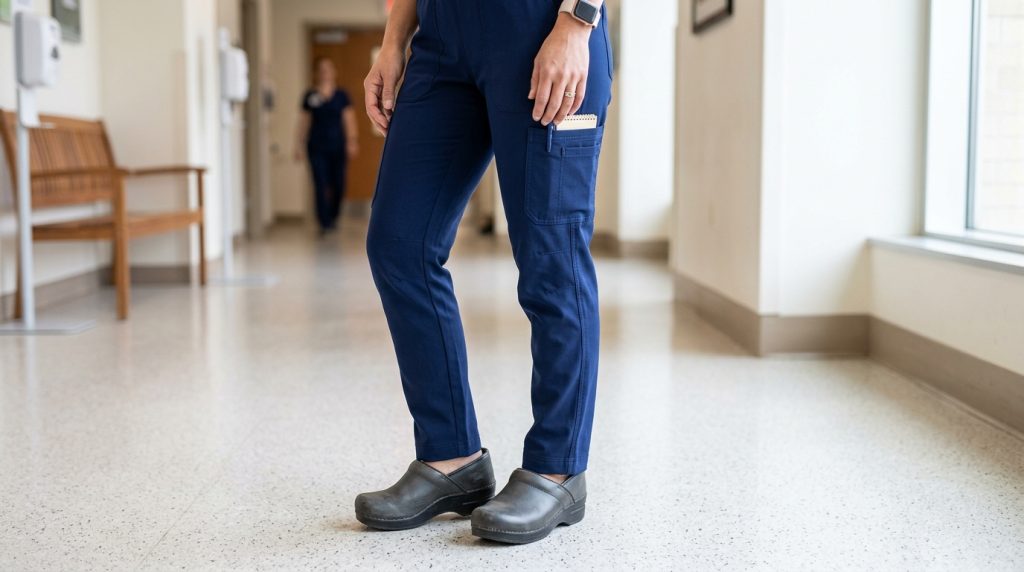
Many scrub pants are shaped through the leg.
This is especially noticeable in:
- Joggers
- Tapered pants
- Cargo pants
- Articulated styles
- Pants with knee seams
- Flare pants
If the garment’s intended knee point falls below the wearer’s knee, the pants may bunch or bend incorrectly.
Signs Knee Placement Is Too Low
- Fabric gathers above the calf
- Folds form behind the knee while standing
- Tapering feels delayed
- Cargo pockets sit unusually low
- Flare begins below the correct point
Signs Knee Placement Is Too High
- Fabric tightens when the knee bends
- Lower-leg proportions appear unusually long
- Shaped seams pull during movement
A petite pattern may reposition the knee, while simply shortening a regular pant usually does not.
How Do Short and Petite Jogger Scrub Pants Differ?
Joggers make length problems especially visible because they end in a fitted cuff.
Regular Joggers That Are Too Long
Excess fabric may:
- Stack above the cuff
- Fold behind the knee
- Create a loose lower-leg appearance
- Make the cuff sit below its intended position
Short-Length Joggers
A short jogger may reduce the amount of leg fabric while keeping the general proportions of the regular garment.
This can work well when the rise and knee position are already correct.
Petite Joggers
A petite jogger may provide better proportions if:
- The rise is also too long
- The knee point sits too low
- The taper begins too far down the leg
- Cargo pockets are misplaced
- Several areas bunch simultaneously
Check the Cuff
The jogger cuff should:
- Sit comfortably around the ankle
- Avoid excessive pressure
- Remain reasonably stable
- Avoid large amounts of stacked fabric above it
Some upward movement while sitting is normal.
What About Tapered Scrub Pants?
Tapered pants narrow progressively toward the ankle but generally use a conventional hem rather than a jogger cuff.
When regular tapered pants are too long, the narrowing may occur too low on the leg.
The result can be:
- Extra material around the knee
- Tightness lower on the calf
- Fabric stacking around the ankle
- A silhouette that does not follow the leg properly
If the upper proportions fit correctly, short scrub pants may be enough.
If the entire taper appears vertically misplaced, petite sizing may provide better proportions.
What About Straight-Leg Scrub Pants?
Straight-leg pants make inseam problems particularly easy to identify.
Because the leg remains relatively consistent in width, excess length often appears around:
- Shoes
- Ankles
- Lower calf
If everything above the ankle fits correctly, short length may be the simplest solution.
Signs Short Length May Be Enough
- Rise feels natural
- Knee sits correctly
- Front pockets lie flat
- Back pockets are positioned correctly
- Only the hem is excessive
Signs Petite May Fit Better
- Seat sags
- Rise feels long
- Knees sit too low
- Pockets are proportionally misplaced
- Excess fabric appears throughout the leg
How Do Flare Scrub Pants Change the Decision?
Flare pants fit relatively closer through the upper leg and widen below the knee.
Correct knee placement is especially important because it determines where the flare begins.
If Regular Flare Pants Are Simply Too Long
A short-length version may place the hem correctly while preserving the intended flare.
If the Flare Begins Too Low
Petite proportions may work better because shortening only the hem does not reposition the knee or flare point.
Check With Work Shoes
A wider hem should remain clear of the floor.
Flare pants should be tested with the footwear normally worn at work because even a small amount of extra length can cause the hem to:
- Drag
- Fold under the shoe
- Wear at the back
- Collect around footwear
How Do Cargo Pockets Help Identify the Correct Length Category?
Cargo pockets provide another useful visual reference.
A thigh pocket should generally remain:
- Accessible
- Comfortably above the knee
- Away from major bending points
- Comfortable during sitting
When a Regular Cargo Pant Is Too Long Overall
The cargo pocket may sit:
- Very close to the knee
- Below a comfortable reach point
- Across an area that bends repeatedly
If hemming the pants would leave the pocket too low, the problem is not limited to inseam.
A petite pattern may position the cargo pocket more appropriately.
Test the Pocket While Sitting
Place a normal lightweight item in the pocket and sit.
Check whether it:
- Presses against the knee
- Interferes with bending
- Feels awkward against the thigh
- Remains easily accessible
Pocket placement should contribute to the short-versus-petite decision.
Can Short-Length Scrub Pants Still Be Too Long?
Yes.
“Short” is a manufacturer’s size designation, not a universal inseam.
Different collections may use different measurements.
Someone may have an inseam shorter than the available short version.
In that situation, options may include:
- Trying petite sizing
- Choosing a different collection
- Selecting another pant silhouette
- Professionally hemming a pant whose other proportions fit correctly
Always review the actual inseam instead of assuming that a short label guarantees the right length.
Can Petite Scrub Pants Still Be Too Short?
Yes.
A wearer may have petite proportions through the rise and knees but require additional inseam length.
For example, someone may have:
- Shorter rise
- Petite hip-to-knee distance
- Relatively longer lower legs
A standard petite inseam might be too short.
Possible alternatives include:
- Another petite collection with a longer inseam
- Short-length regular pants
- Regular length in a naturally shorter-fitting style
The goal is correct proportions, not loyalty to a size-category label.
Why Do Scrub Pants Bunch Behind the Knees?
Bunching can have several causes.
Excess Leg Length
Extra material shifts upward as the knee bends.
Knee Position Is Too Low
The pant bends at a different point from the body.
Calf Is Too Tight
A narrow lower leg may prevent fabric from falling naturally.
Thigh Is Too Loose
Excess material can migrate downward.
Taper Is Misaligned
The leg begins narrowing below the ideal position.
Fabric Has Poor Recovery
Stretch fabric may remain loose after repeated bending.
Some gathering while sitting is normal. Persistent folds while standing are more likely to indicate a fit issue.
Why Do Short Scrub Pants Sometimes Still Bunch?
A shorter inseam corrects only one possible cause.
If bunching remains after moving from regular to short sizing, check:
- Rise
- Knee placement
- Thigh width
- Calf fit
- Pant taper
- Fabric recovery
This is a strong indication that a different proportion or silhouette may be needed.
Why Do Scrub Pants Drag on the Floor?
Dragging may result from more than inseam length.
Potential causes include:
- Excess inseam
- Waistband sitting too low
- Rise that is too long
- Pants being too large overall
- Wide or flare hem
- Different footwear
- Heavy pockets pulling the pants downward
Check the Waist Before Altering the Hem
If a loose waistband allows the pants to slide down an inch, the garment may appear an inch longer.
Correct the waist position first.
Then reassess the hem.
Can Hemming Regular Scrub Pants Replace Petite Sizing?
Sometimes.
Hemming is most appropriate when:
- Waist fits correctly
- Rise is correct
- Hip and thigh proportions are right
- Knee placement is correct
- Pockets sit appropriately
- Only the lower leg is too long
In that situation, changing the hem can solve the fit problem.
Hemming Does Not Correct:
- Excess rise
- Low crotch position
- Incorrect knee placement
- Low cargo pockets
- Taper starting too far down
- Overall leg proportion
When several of those issues exist, petite sizing may provide a better starting point.
Should Jogger Scrub Pants Be Hemmed?
Joggers can be more complicated to alter because the cuff is part of the pant construction.
Shortening a jogger may require:
- Removing the cuff
- Shortening the leg
- Recreating the taper
- Reattaching the cuff
If the pant is shortened without preserving the intended taper, the cuff may no longer fit naturally.
When available, buying the correct short or petite jogger is generally simpler than substantially reconstructing the lower leg.
Which Measurements Matter Most When Shopping Online?
When comparing short and petite pants online, look for:
- Waist range
- Hip range
- Front rise
- Back rise
- Inseam
- Thigh measurement
- Leg opening
- Pant silhouette
- Available length designation
Some product pages may provide only part of this information.
Body vs Garment Measurements
A size chart may show either:
Body measurements: Dimensions of the intended wearer.
Garment measurements: Actual physical dimensions of the pants.
These should not be compared as though they are identical.
Garments require some allowance for movement, depending on fabric and fit.
What if the Size Chart Lists Only Inseam?
If only inseam differs between the manufacturer’s regular, short, and petite categories, use the information provided rather than assuming additional pattern changes.
This is important because petite terminology is not completely standardized.
The safest approach is to:
- Read the specific size chart.
- Review the fit description.
- Compare model information when available.
- Ask the retailer about rise or proportional differences when necessary.
- Test one pair before purchasing several.
General apparel terminology should never override the actual specifications of the garment being considered.
How Should Waist and Hip Measurements Be Taken?
Waist
Measure around the natural waist or the location specified by the product sizing instructions.
Keep the tape:
- Level
- Comfortably close
- Not excessively tight
Hips
Measure around the fullest area of the hips and seat.
Keep the tape parallel to the floor.
New Mexico State University’s pant-fitting guidance includes waist and hip measurements along with thigh, knee, crotch, and length measurements, illustrating why several dimensions contribute to lower-body fit. (NMSU Publications)
What if Waist and Hip Measurements Fall Into Different Sizes?
This is common.
For example:
- Waist may correspond to small
- Hips may correspond to medium
Possible solutions include:
- Choosing the size that accommodates the hips
- Using an adjustable drawstring
- Selecting a contoured waistband
- Trying a different pant cut
- Choosing a stretch fabric
- Comparing another collection
Do not intentionally undersize the hip area just to achieve a tighter waistband.
The pants should allow comfortable sitting and movement.
Does Fabric Affect Whether Short or Petite Pants Fit Better?
Fabric changes how fit problems appear.
Stretch Fabric
Stretch can temporarily make a slightly incorrect fit feel more forgiving.
However, it cannot reposition:
- Knees
- Pockets
- Rise
- Taper
Structured Fabric
A structured textile may make excess material more visible because folds remain more defined.
Soft Draping Fabric
Soft fabric may hide minor excess length visually but can still bunch during movement.
Fabric Recovery
Recovery matters around:
- Knees
- Seat
- Waistband
- Thighs
A pant that becomes increasingly loose during the day may appear longer as the fabric loses shape.
Which Waistband Works Best for Shorter Scrub Pants?
Waistband preference depends on body shape rather than pant length category.
Common options include:
- Full elastic
- Drawstring
- Elastic plus drawstring
- Wide knit waistband
- Flat-front waistband
Why Waistband Security Matters
A loose waistband can allow pants to slide downward.
That affects:
- Crotch position
- Knee placement
- Pocket location
- Hem length
A pair of correctly sized short pants can still drag if the waistband does not remain at its intended position.
Should You Size Down to Make Scrub Pants Shorter?
Usually not.
Sizing down changes several dimensions simultaneously.
It may reduce:
- Waist circumference
- Hip room
- Thigh width
- Rise
- Overall ease
This can create restriction even if the pants appear slightly shorter.
Length problems are better addressed through the correct length category or alteration than by intentionally choosing an undersized garment.
Should You Size Up to Get a Longer Petite Inseam?
Again, not usually.
Sizing up may add unwanted:
- Waist room
- Hip room
- Rise
- Thigh width
while providing little or no additional inseam.
When petite pants fit proportionally but are too short, compare:
- Another petite style
- Another collection
- Short-length regular pants
- Actual inseam measurements
The size itself should remain based on body fit.
How Should Short and Petite Scrub Pants Work With Shoes?
Footwear affects the final hem position.
Joggers
Cuffs typically sit around the ankle and keep the shoe visible.
Tapered Pants
The hem should fall cleanly without heavy stacking.
Straight-Leg Pants
The hem should approach the shoe without dragging beneath it.
Flare Pants
The wider hem requires particularly careful length selection.
Whatever the silhouette, the pants should not:
- Drag under the heel
- Catch beneath the shoe
- Create excessive folds
- Restrict ankle movement
Fit tests should therefore include footwear similar to what will be worn at work.
How Can You Test Short and Petite Scrub Pants in Person?
When possible, compare both categories rather than assuming one is correct.
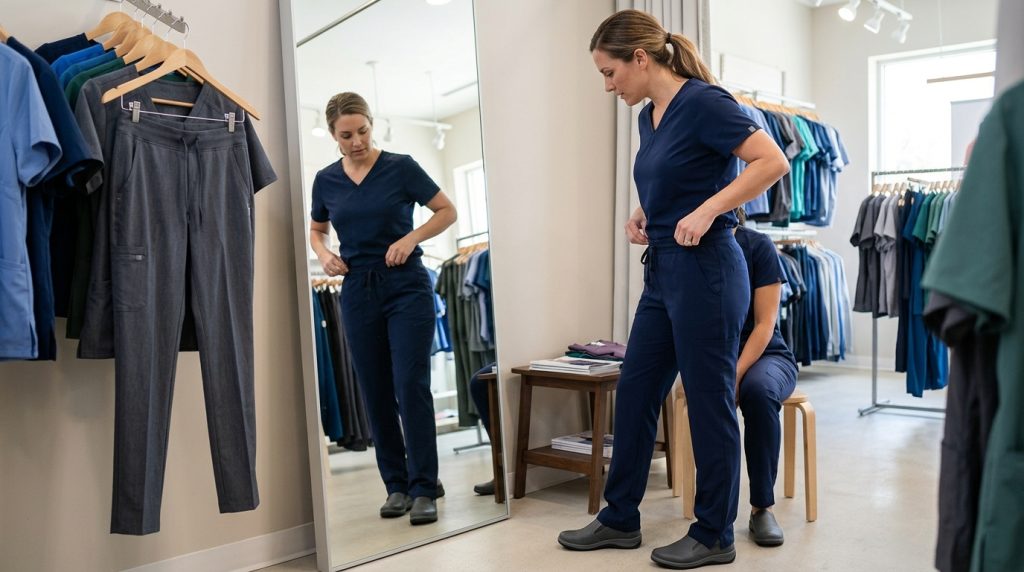
The Short vs Petite Fit Test
Wear normal work underlayers and shoes.
Then:
- Check waistband position.
- Check the crotch and rise.
- Locate where the knee shaping sits.
- Check cargo pocket position.
- Examine the taper.
- Look at the hem.
- Sit fully in a chair.
- Stand without adjusting the pants.
- Walk several steps.
- Bend at the knees.
- Raise one knee.
- Recheck the hem and knee position.
Professionals who want to compare these proportions before ordering can visit a local scrub store in Lincoln and evaluate short, petite, and regular options through actual movement.
How Can You Decide Between Short and Petite in Five Minutes?
Use this simplified process.
Choose Short Length First If:
- Regular waistband fits
- Regular rise fits
- Regular hips fit
- Regular knee placement fits
- Pockets sit correctly
- Only the hem or lower leg is too long
Try Petite First If:
- Rise feels too long
- Crotch hangs low
- Knees are positioned too low
- Cargo pockets fall too low
- Taper begins too late
- Excess material appears throughout the pant
Try a Different Cut If:
- Neither short nor petite fits the thighs
- Calves remain too tight
- Waist and hips do not work together
- Rise remains uncomfortable
- The pant twists during movement
Sometimes the problem is the garment’s basic cut rather than the length category.
How Should New Scrub Pants Be Checked Before Washing?
Do not immediately remove tags and wash a new pair.
First:
- Confirm the waist
- Check seated rise
- Test hip and thigh movement
- Confirm knee placement
- Check pocket position
- Verify the inseam
- Wear normal work shoes
- Review the return policy
Washing can affect both garment condition and return eligibility.
Can Washing Change Scrub Pant Length?
It can, depending on the fabric and construction.
Changes may affect:
- Inseam
- Waistband
- Overall dimensions
- Fabric texture
- Stretch recovery
The Federal Trade Commission’s Care Labeling Rule requires covered apparel to provide regular care instructions to purchasers. (Federal Trade Commission)
Follow those instructions rather than intentionally trying to shrink a garment into the correct size.
Why Intentional Shrinking Is Unreliable
Shrinkage may not occur evenly.
It can affect:
- Length
- Width
- Rise
- Fabric feel
- Elasticity
- Seam appearance
Choosing the correct original proportions is more reliable.
Common Mistakes When Choosing Short or Petite Scrub Pants
Choosing Based Only on Height
Height does not show how body length is distributed.
Assuming Short and Petite Are Identical
They may use different pattern proportions.
Looking Only at the Hem
Rise, knees, taper, and pockets can reveal whether the entire pant is too long.
Hemming Before Checking Knee Placement
Shortening the hem does not reposition the knee.
Ignoring Cargo Pocket Position
Low pockets can signal incorrect vertical proportions.
Sizing Down to Reduce Length
This may create tightness elsewhere.
Sizing Up to Gain Length
This may create excess waist, hip, and rise room.
Buying Multiple Pairs Immediately
Test one new length and style first.
Comparing Labels Instead of Measurements
One manufacturer’s short or petite sizing may differ from another’s.
Testing Only While Standing
Rise and knee problems often appear during seated movement.
Washing Before Confirming Fit
The pants may become ineligible for return or exchange.
Short vs Petite Scrub Pants Decision Checklist
Consider Short Length When:
- Waist fits correctly
- Rise feels comfortable
- Hip and thigh proportions work
- Knee sits correctly
- Pockets are positioned well
- Only the leg or hem is too long
Consider Petite Sizing When:
- Regular rise feels excessively long
- Crotch hangs lower than intended
- Knees sit too low
- Cargo pockets fall too low
- Taper begins below the correct point
- Bunching occurs throughout the pant
- Hemming alone would leave other proportions incorrect
Before Purchasing:
- Measure waist
- Measure hips
- Measure inseam
- Compare rise when available
- Check the product-specific size chart
- Wear normal work shoes during fitting
- Test sitting and bending
- Confirm return conditions
- Order one pair before buying several
Conclusion
The difference between short-length and petite scrub pants comes down to where the garment needs to become shorter.
Short sizing is often most appropriate when regular pants fit correctly through the waist, hips, rise, knees, and pockets but provide too much lower-leg length.
Petite sizing may be more appropriate when the entire pant feels vertically oversized, including the rise, knee position, taper, pockets, and inseam.
Instead of asking only, “Are these pants too long?” ask:
- Is the rise correct?
- Where does the knee sit?
- Are the pockets positioned properly?
- Does the taper match the leg?
- Where does the hem fall?
Those questions make it easier to distinguish an inseam problem from an overall proportion problem and choose scrub pants that fit correctly from waistband to shoe.
Frequently Asked Questions
Are short and petite scrub pants the same?
Not necessarily. Short-length pants may primarily reduce the inseam, while petite pants may also adjust the rise, knee position, pockets, taper, and overall proportions. The exact differences depend on the manufacturer.
Who should wear short-length scrub pants?
Short-length scrub pants may work well for someone whose regular pants fit correctly at the waist, hips, rise, and knees but have too much fabric through the lower leg or hem.
Who should wear petite scrub pants?
Petite scrub pants may suit someone whose regular pants are proportionally too long through several areas, such as the rise, knees, pockets, taper, and inseam.
Can a tall person need short scrub pants?
Potentially. Overall height does not determine inseam by itself. Someone can have a longer torso and proportionally shorter legs. Actual inseam and garment measurements are more useful than height alone.
Can a short person wear regular-length scrub pants?
Yes. A shorter person may have relatively long legs and fit a regular inseam well. Height should be treated as a general clue rather than a strict sizing rule.
Why do scrub pants bunch behind my knees?
Bunching can result from excess length, incorrect knee placement, loose thighs, tight calves, misplaced taper, or fabric with poor recovery. If hemming does not correct the problem, a petite or differently proportioned style may fit better.
Should I choose petite scrubs or have regular pants hemmed?
Hemming works well when the waist, rise, hips, knees, taper, and pockets already fit correctly. Petite sizing is usually worth considering when several of those proportions also sit too low.
How do I know my correct scrub pant inseam?
Measure the inside leg of a pair of work pants that already fits properly, starting at the crotch seam and ending at the hem. Compare that measurement with the specific scrub pant’s size chart.